TERAKREDITASI SINTA 5
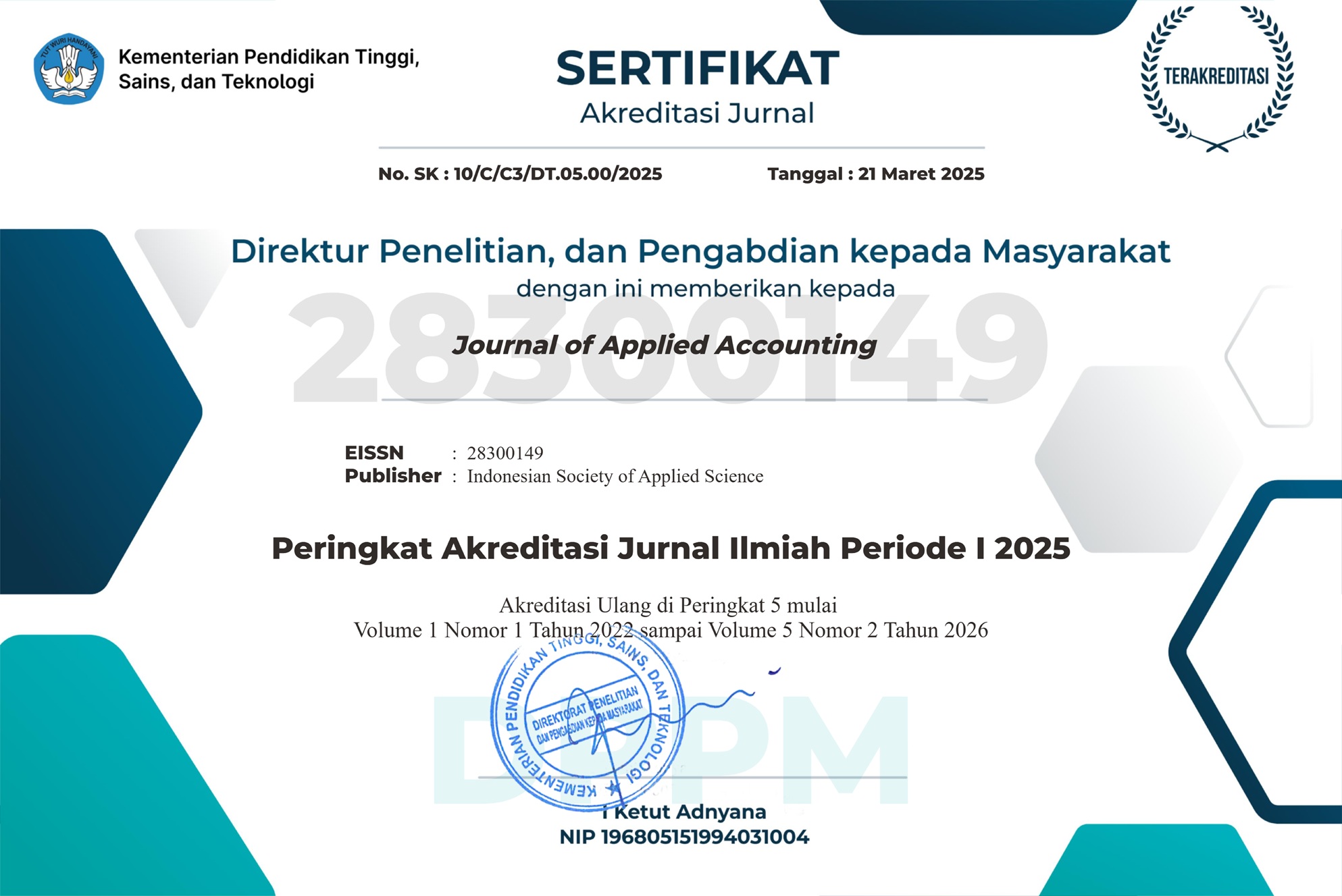

Download

TOOLS
 |
 |
 |

INDEXED BY



Publication Ethics
The Journal of Applied Accounting (JAA), published by the Indonesia Society of Applied Science (ISAS), is committed to maintaining the highest standards of publication ethics and research integrity. The journal seeks to ensure that all stages of the publication process are conducted with transparency, fairness, accountability, and respect for ethical principles.
This publication ethics policy applies to authors, editors, reviewers, and the publisher. All parties involved in the publication process are expected to uphold academic integrity and contribute to the responsible dissemination of scientific knowledge.
Authors submitting manuscripts to JAA must ensure that their work is original, accurate, and free from plagiarism. Manuscripts must not have been published previously or be under consideration by another journal.
Authors are responsible for:
Editors are responsible for managing the editorial process fairly, objectively, and confidentially. Editorial decisions must be based on the manuscript's academic quality, originality, relevance to the journal's scope, methodological soundness, and contribution to the field.
Editors must not discriminate against authors based on personal characteristics, institutional affiliations, nationality, or other irrelevant factors. They must also identify and manage potential conflicts of interest and take appropriate action when ethical concerns arise.
Reviewers are expected to evaluate manuscripts objectively, constructively, and within the agreed review period. Their assessments should focus on the originality, quality, methodology, relevance, and academic contribution of the submitted work.
Reviewers must maintain the confidentiality of manuscripts, avoid using unpublished information for personal advantage, disclose potential conflicts of interest, and inform the editor of any suspected plagiarism or significant ethical concerns.
The Indonesia Society of Applied Science (ISAS), as the publisher of JAA, supports responsible publishing practices and the protection of academic integrity. The publisher works with the editorial team to maintain transparent editorial procedures and address credible allegations of publication misconduct appropriately.
All submitted manuscripts may be screened for plagiarism and textual similarity. Authors must provide appropriate citations and acknowledgments for ideas, data, quotations, and materials obtained from other sources.
Plagiarism, data fabrication, data falsification, duplicate submission, and other forms of research misconduct are unacceptable. Where concerns arise, the editorial team may request clarification, require revisions, reject the manuscript, or take other appropriate action in accordance with the journal's procedures.
Authors, editors, and reviewers must disclose any financial, professional, personal, or institutional relationships that could influence, or reasonably appear to influence, their decisions or judgments.
The editorial team will take appropriate steps to manage disclosed conflicts of interest and preserve the fairness and integrity of the review process.
JAA evaluates submitted manuscripts through an editorial screening and peer-review process. Manuscripts are assessed according to their scholarly quality, originality, methodological rigor, relevance, and contribution to accounting knowledge and practice.
Editors make publication decisions after considering the review reports and the journal's editorial standards. Payment of publication fees does not guarantee acceptance or influence the academic evaluation of a manuscript.
If significant errors or credible allegations of misconduct are identified before or after publication, the journal will assess the available evidence and take appropriate action to protect the integrity of the scholarly record.
Depending on the circumstances, actions may include requesting corrections, publishing a correction or retraction notice, rejecting a manuscript, or contacting relevant institutions when necessary.
Authors, reviewers, and readers may report suspected ethical violations or concerns to the editorial team for appropriate assessment.
The Journal of Applied Accounting is committed to promoting responsible research, transparent editorial practices, fair peer review, and respect for intellectual property. All participants in the publication process are expected to comply with this policy and contribute to maintaining the credibility of scholarly publishing.
For further information, please visit the official Journal of Applied Accounting website.
|
|
|
 This Journal of Applied Accounting (JAA) is licensed under a Creative Commons Attribution 4.0 International License.