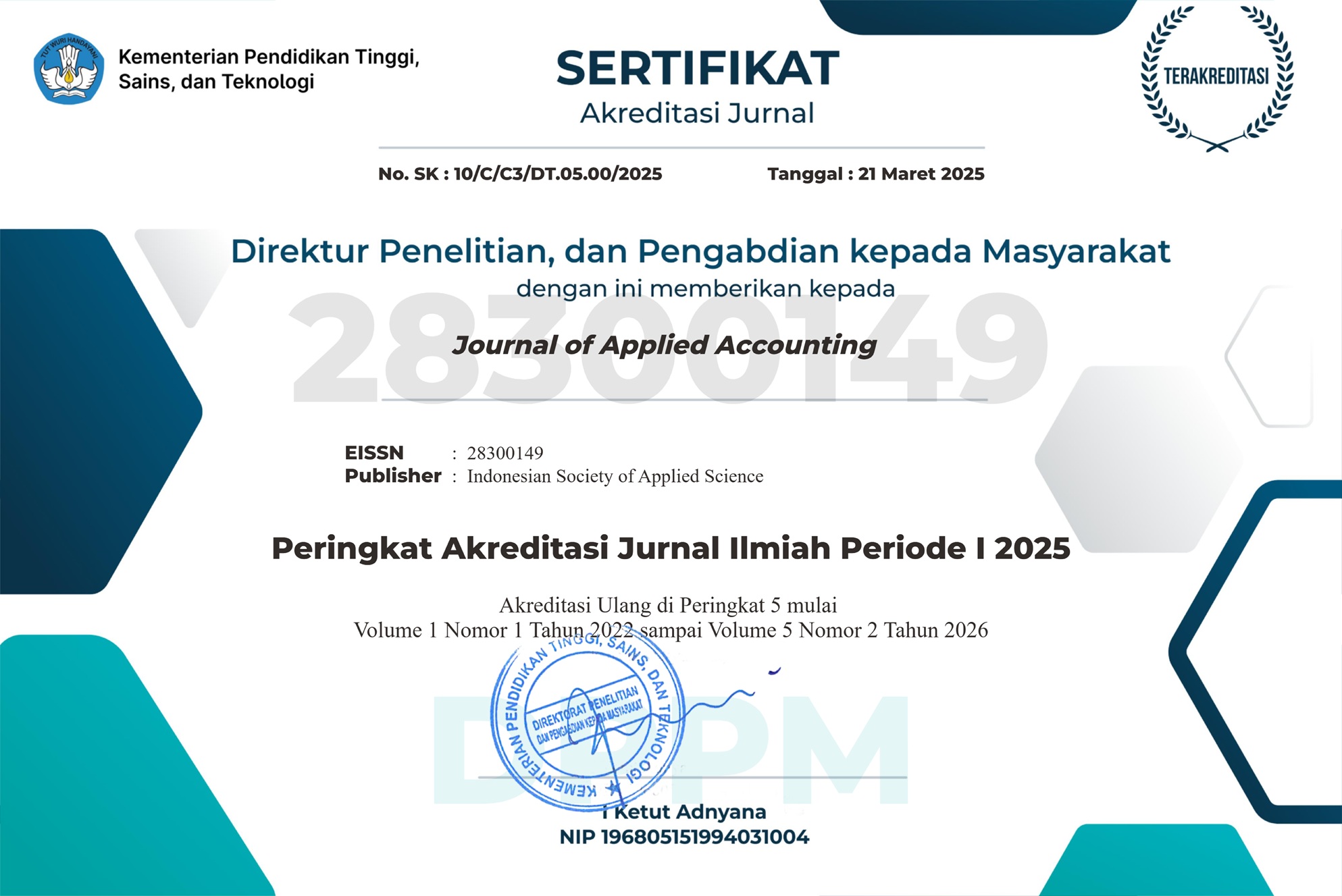
TERAKREDITASI SINTA 5

Download

TOOLS
 |
 |
 |

INDEXED BY







Artificial Intelligence (AI) Policy
The Journal of Applied Accounting (JAA)
Publisher: Indonesia Society of Applied Science (ISAS)
The Journal of Applied Accounting (JAA) recognizes the potential of Artificial Intelligence (AI) and AI-assisted technologies to support academic research, scholarly writing, data analysis, and the dissemination of scientific knowledge. This policy establishes guidelines for the responsible, transparent, and ethical use of AI tools in the preparation, submission, review, and publication of manuscripts.
The policy applies to authors, reviewers, editors, and other parties involved in the editorial and publication processes of JAA.
Authors may use AI tools to assist with language editing, grammar correction, translation, improving readability, organizing ideas, and other legitimate research-support activities. However, AI tools must not replace the authors' intellectual contributions, critical thinking, independent judgment, or responsibility for the scientific content of their manuscripts.
Authors must ensure that all AI-generated or AI-assisted content is carefully reviewed and verified before submission. Any use of AI must comply with applicable research ethics standards and the principles of academic integrity.
Authors must disclose the use of generative AI tools or AI-assisted technologies when such tools have contributed substantively to the preparation of a manuscript, including the generation of text, interpretation of findings, preparation of research materials, or other relevant scholarly content.
The disclosure should identify the AI tool used, its purpose, and the relevant activities in which it was involved. Routine spelling, grammar, and reference-formatting tools that do not generate substantive content generally do not require disclosure.
A disclosure statement may be included in a dedicated section entitled “Declaration of Generative AI and AI-Assisted Technologies in the Writing Process.”
Suggested statement:
“During the preparation of this manuscript, the author(s) used [name of AI tool] for [specific purpose]. The author(s) reviewed and edited the resulting content and take full responsibility for the accuracy, originality, integrity, and final content of the manuscript.”
If no generative AI tools were used in preparing the manuscript, authors may state:
“The author(s) declare that no generative AI tools were used in the preparation of this manuscript.”
AI tools must not be used to fabricate or falsify research data, generate misleading findings, manipulate research results, create false references, or misrepresent the work of other researchers.
Authors are fully responsible for verifying the accuracy of facts, citations, references, calculations, data interpretations, and conclusions, including any content produced or modified with AI assistance.
AI tools cannot be listed as authors or co-authors because they cannot assume responsibility for the research, approve the final manuscript, or be held accountable for its contents. Authorship must be limited to individuals who meet the applicable authorship criteria.
The use of AI does not exempt authors from complying with JAA's plagiarism policy, copyright requirements, and standards of research integrity.
Authors must ensure that their manuscripts represent original scholarly work and appropriately acknowledge the ideas, data, and words of other sources. AI-generated content that reproduces copyrighted material, contains unattributed borrowed text, or misrepresents existing research may constitute a violation of publication ethics.
Manuscripts suspected of plagiarism, fabricated information, falsified data, or other forms of research misconduct may be subject to editorial investigation and appropriate action in accordance with the journal's publication ethics policies.
Reviewers must maintain confidentiality and protect the intellectual property of submitted manuscripts. They must not upload unpublished manuscripts, confidential research data, or identifiable author information to public or third-party AI systems without appropriate authorization and safeguards.
AI tools must not replace the reviewer's independent scholarly judgment. Reviewers remain responsible for the accuracy, fairness, confidentiality, and professional integrity of their evaluations.
Any use of AI in preparing a peer-review report must comply with the journal's confidentiality requirements and applicable editorial instructions.
Editors may use appropriate AI-assisted technologies to support administrative tasks, language assessment, manuscript screening, and editorial workflow management, provided that confidentiality and data protection are maintained.
AI systems must not independently determine acceptance, revision, or rejection decisions. All editorial decisions must be made by qualified human editors based on the manuscript's scientific quality, originality, relevance, methodological rigor, and compliance with publication ethics.
Editors must also ensure that AI-assisted screening results are interpreted cautiously and do not constitute the sole basis for allegations of misconduct or editorial decisions.
Authors must disclose the use of generative AI in creating or substantially modifying images, figures, illustrations, tables, or other research materials when such use is relevant to the scientific content of the manuscript.
AI-generated or AI-modified materials must not misrepresent evidence, alter research findings, or create misleading visual representations of data. Authors must comply with applicable copyright, licensing, and research ethics requirements.
The use of AI to fabricate, manipulate, or falsify empirical data, experimental results, financial records, audit evidence, or other research evidence is strictly prohibited.
The Journal of Applied Accounting reserves the right to investigate suspected violations of this policy. Depending on the nature and severity of the violation, the journal may request clarification or corrections, reject a manuscript, retract a published article, or take other appropriate action consistent with its publication ethics procedures.
Authors, reviewers, and editors are expected to cooperate with reasonable editorial inquiries concerning the use of AI and the integrity of submitted or published work.
JAA may periodically review and update this policy to reflect developments in AI technologies, scholarly publishing standards, and research ethics. All parties involved in the publication process are expected to comply with the version of the policy applicable at the time of submission or editorial assessment.
The Journal of Applied Accounting is committed to promoting responsible innovation while safeguarding academic integrity, research transparency, confidentiality, and the credibility of scholarly publication.
|
|
|
 This Journal of Applied Accounting (JAA) is licensed under a Creative Commons Attribution 4.0 International License.